Always Moving – Even When You Stop
Published in ROW360 Magazine - August 12, 2025

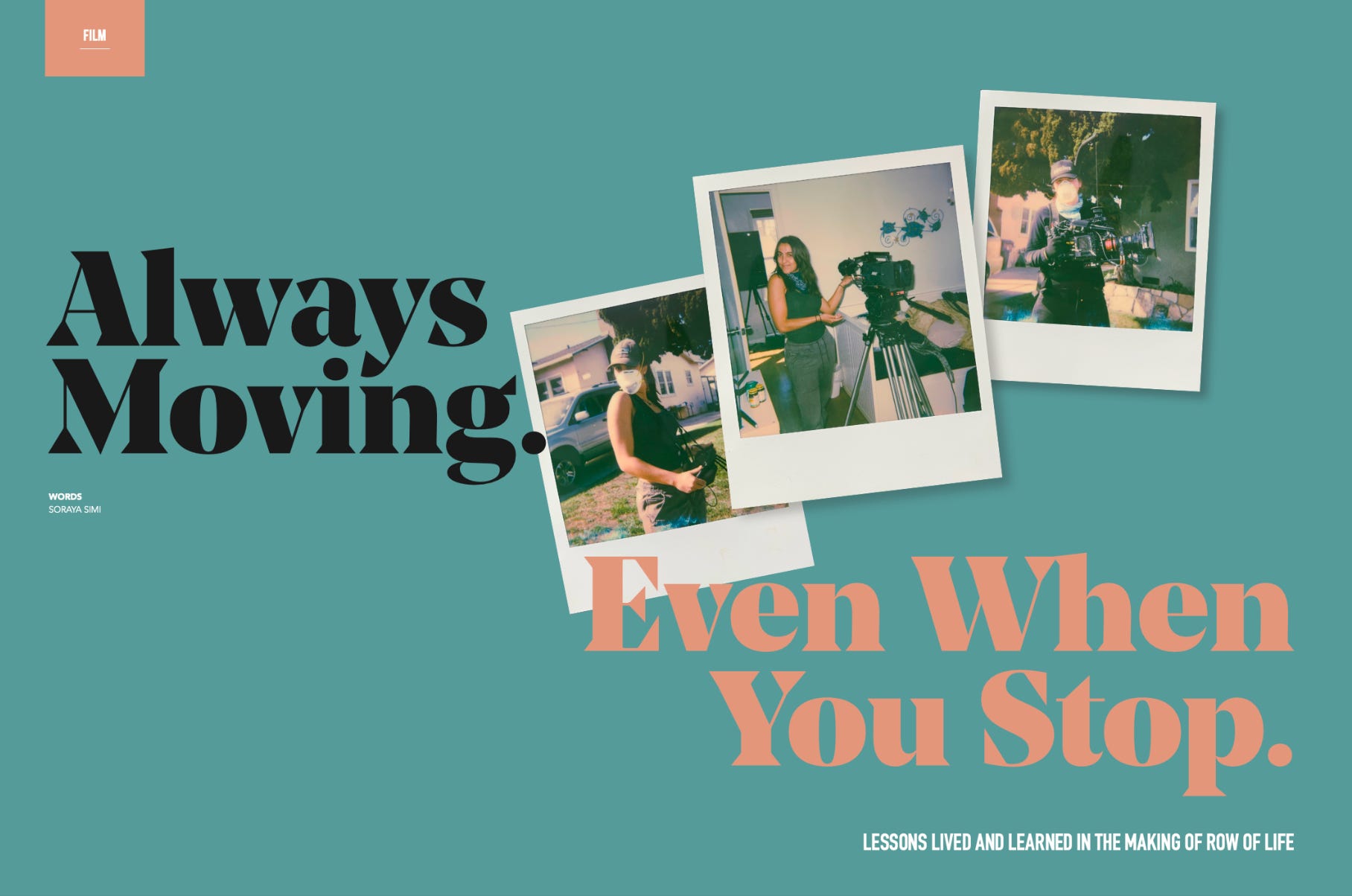
It’s refreshing writing a piece for a rowing magazine as I don’t have to fill in as many blanks as l normally do. In other outlets, the average reader has often never heard of ocean rowing, but here I can safely assume that either you yourself are a rower, or, like me, unexpectedly (perhaps even involuntary) became an ancillary member of this institution.
Which means you’ve probably already heard of Angela Madsen.
Angela, a three-time Paralympian, fourteen-time Guinness World Record holder, and Marine Corps veteran rowed the Atlantic twice, the Indian once, and circumnavigated Great Britain. She was rescued ten days into her first solo attempt across the Pacific in 2013, but in 2014, successfully crossed with ocean rower Tara Remington. In 2020, Angela once more attempted to be the oldest woman and only paraplegic in the world to row solo and unassisted across the Pacific Ocean. Tragically, sixty days in, Angela drowned halfway between Los Angeles and Hawaii. In a sport where only eight recorded fatalities exist, this one sticks out.
But let’s back up a bit.
The first question everyone asks me, the filmmaker following this story, is how Angela and I first met.
Angela contacted me via Facebook after she watched a sailing documentary I produced and directed which was touring sailing clubs in California.
When I was 21. I took a semester off from film school to accomplish a lifelong dream of living on a sailboat.
The dreamy picture in my mind quickly evaporated as chronic sea-sickness, physical exhaustion, and extreme sleep deprivation took over.
Academically, the program (Sea Education Association) was rigorous, and keeping up with the mental sweat in addition to the awkwardness of learning to be a “real” sailor (that is to say — without the facilitation of contemporary gadgets and gizmos like GPS, for example), was profoundly intense. In typical fashion, I added another variable to the equation: document the entire trip and make a film about the experience, which became a 25 minute film called Where the Water Takes Us.
Angela, to her credit, watched the entire thing. I don’t share this out of modesty, but curiosity, as I will always wonder what it is she saw in a film I don’t personally find to be the strongest example of my filmmaking or storytelling capacities (it’s alright at best). I can’t help but cringe when I watch it, knowing how the odds were so stacked against me: shooting through nausea, fatigue, virtually no budget, lower-than-preferred production value, and certain creative liberties to find cohesion in a plot that tried to be about too many things... In spite of this, l swallowed my ego and forced myself to finish what I started. Laying this foundation would pay off later.
Maybe Angela liked the fact that here was a filmmaker with some real, white-knuckle, bare bone experience of living at sea. I was al filmmaker who could talk the talk, walk the walk, and, most importantly, loved the ocean. Oh, how I love the ocean. I love the infinite palette of colour and light. I love being attuned to the slightest shift in wind or current. I love the dynamism in coditions, from a squall one minute and glassy stillness the next. I love salt water showers on deck — especially under the glorious canopy of the Milky Way. I love listening to live hydrophone recordings of humpback whales’ songs or the bioluminescent glow of dolphins chasing the bow — beauty one can enjoy even while puking off the starboard side. I love catching waves and feeling like a part of something bigger than me. I love how each trial at sea is interwoven with an undeniable lesson, a moment of unexpected beauty, and perpetual, often even profound testaments of magic.
The ocean, Angela and I could easily agree, was our shared muse and greatest teacher.
What I didn’t know until I met Angela was that people rowed across them.
No sail or motor, no follow boat or any kind of assistance. Months at sea being tossed like a jerry can in a mere 20’ vessel was a lot to wrap my head around before contemplating the even rarer breed of ocean rower who volunteers to do it alone. Why alone? It was this question that hooked me, but it was Angela who lured me in.
Angela, at 60, with an untamed mane of grey hair, no sensation below her lumbar spine, a wildly inappropriate sense of humour, and a radiant face of joy was unlike anyone I had ever met or anyone I had ever seen in a film. She was born to be on camera, and whose life story (actively unfolding) was more interesting than anyone I knew. After spending four years in film school righteously declaring to tell stories about the untold, I would be foolish not to embrace the opportunity when it arrived at my doorstep (or slid into my DMs).
And so, a seemingly innocuous Facebook message: “Hey, I am going to row the ocean solo. Do you want to make a little video about it?” turned into a sharp left turn and the greatest understatement of my lifetime.
Now, six years later, Row of Life is my first feature film that follows Angela’s remarkable legacy as an athlete, an ocean rower, a devoted wife, and extraordinary individual leading up to her final solo row across the Pacific Ocean in 2020.
It’s a film about a lot of things. It is a love story — a selfless, unconditional love that Angela’s life partner, Deb — the steady, unwavering cheerleader back home — exemplifies by championing Angela’s pursuit of her dreams despite what becomes the ultimate cost.
It is a story of a promise kept — a lesson in front of and behind the lens to never, ever give up and see through to the mission of finishing what was started, no matter the twists and turns, tragedies or triumphs that transpire in between.
It is a story of a destiny felt and manifested, aptly put by Angela herself:
“I’m not afraid of death. It’s going to happen when it’s supposed to happen and when I’m done doing on this earth what l’ve been put here to do, and apparently I’m supposed to do it in this body. The story is supposed to be out there for people, and I’m trying to make that happen.” Still, that pesky question hung overhead — what was this itch, this undeniable, relentless tug in Angela that made her go back time again to her rowing seat, to the vast, powerful ocean for months, and in total isolation?
“She has to get away from me for three months. She needs peace!” Deb teases early on — before we are privy to their intimate exchanges over satellite message, their yearning to be together again on the other side of the Pacific.
Roz Savage, the first woman to row every ocean solo, chimes in, too:
“This desire for greater self-awareness, self-knowledge. To find out who I really was when I wasn’t interacting with somebody else. When I wasn’t somebody’s friend, wife, sister, daughter... to find out who I am when I’m on my own.”
Angela’s answer evolves, from at first insisting that it had everything to do with a personal and public sense of accomplishment. In previous rows with teams of four, six, eight, even sixteen, Angela felt the narrative after the row was successful went along the lines of: “Crew with disabled woman cross ocean”. She never felt fully credited and validated, and instead, suffered from the limits others projected around her disability. This gnawed at Angela. She had to prove them wrong.
But as I worked with Angela and Deb closely for a year leading up to her launch, a new explanation emerged:
“An ocean rowing boat is a relatively safe place compared to society,” Deb expands, “You don’t have to depend on your chair. You can get to where you want to go. And no one knows you’re disabled along the way.”
There it was, quite literally hidden in plain sight: the explanation after all.
The camouflage of it all. The limitless of it all. The freedom.
“No sidewalks, no news, no Trump..” Angela playfully echoes, “It’s peaceful when it’s not like riding a bull. Amazing sunrises and sunsets. Big full moon when it comes over the ocean and it looks like molten silver with little ripples in the water. Sometimes it looks like gold when the sun is setting.
Something different every minute, no two minutes out here are alike. It’s always changing. You’re never at the same Latitude and Longitude either.
Always moving — even when you stop.”
Always moving — even when you stop.
I clung to this line. At just 22 years old, I agreed to make this film with Angela to explore several questions, the pertinent one simply being, why?
What this experience answered along the way was far beyond my wildest imagination or provocations. Six years later, this line still stuns me. I feel it’s Angela’s way of reminding us that despite the unwanted outcome, she hasn’t “stopped” she is only set in a different kind of motion.
This film is like a current beneath her boat, aptly called Row of Life, a momentum that helps propel a profound truth forward: we are all rattling along, some with force and intention, others at the whim of the conditions and circumstance that feel like a retrograde, when really it’s a spiral. Even when we stop, we are still moving in a direction that will always ask of us to become who we really are.
And that, to me, is reason enough to sit in a rowing seat and start pulling the oars.